Winner 2025:
The Passion by Daniel DeVaughn
“Is it to or from the fire?” one asks while reading Daniel DeVaughn’s The Passion, and one is reminded of the Via Crucis, the stations on the way toward an end that is also a beginning; but one is also reminded of the minor agonies of the human abstract coming into Blakean cognizance: what afflicts us is already in the soil of our longing, and our passion remains a terrestrial one, a spectral drama concerning embodiment and the animal rituals of human love and human labor. “All you wanted / was to be a nameless animal / devoured by the body / of the world,” Daniel DeVaughn. writes, and we are called into a world that speaks from “an ellipsis / in the alphabet of dust.” The Passion is a stunning book whose syntactic, rhythmic seductions propel one into a tenderness sustained by the measured weight of its ruminative imagery, the pulsing syncopated luminescence of a world lit up by cherry-red comm towers at night, lush rhododendrons in the violet hour, and an earthen language sundappled and layered in the kudzu of “an undying underlife of green”. As Blaise Pascal had written during his night of fire, what burns in us is the certitude that one may live, forever, for a feeling: the shape of God in a stone under a rippling “thread of river”; a polaroid catching “the after of a mother’s image”; mycelium speaking beneath the understory of human emotion where “the heart’s unseen geometries [are] carved onto the world.” Daniel DeVaughn’s The Passion is a book of wondrous psalmistry, a hymn to the earth, to childhood and memory, and (following Hopkins) to the “dapple-dawn-drawn” forms of heaven that remind us of our suspended mortality.
— Jose-Luis Moctezuma, judge’s citation
Coming out in Spring, 2028
~ ~ ~ ~ ~
Winner 2024:
Hostile Architectures by Nica Giromini
The style of this book lives in the lineage of negative theology, the unsaid. Celan-adjacent, with a postmodern dearth of vocabulary. The ordinary kept strange by the restriction of the voice. The title predicts a deft consistency in the manuscript, which refuses to move because it can’t move.
— Katie Peterson, judge’s citation
Coming out in Fall, 2027
~ ~ ~ ~ ~
Winner 2023:
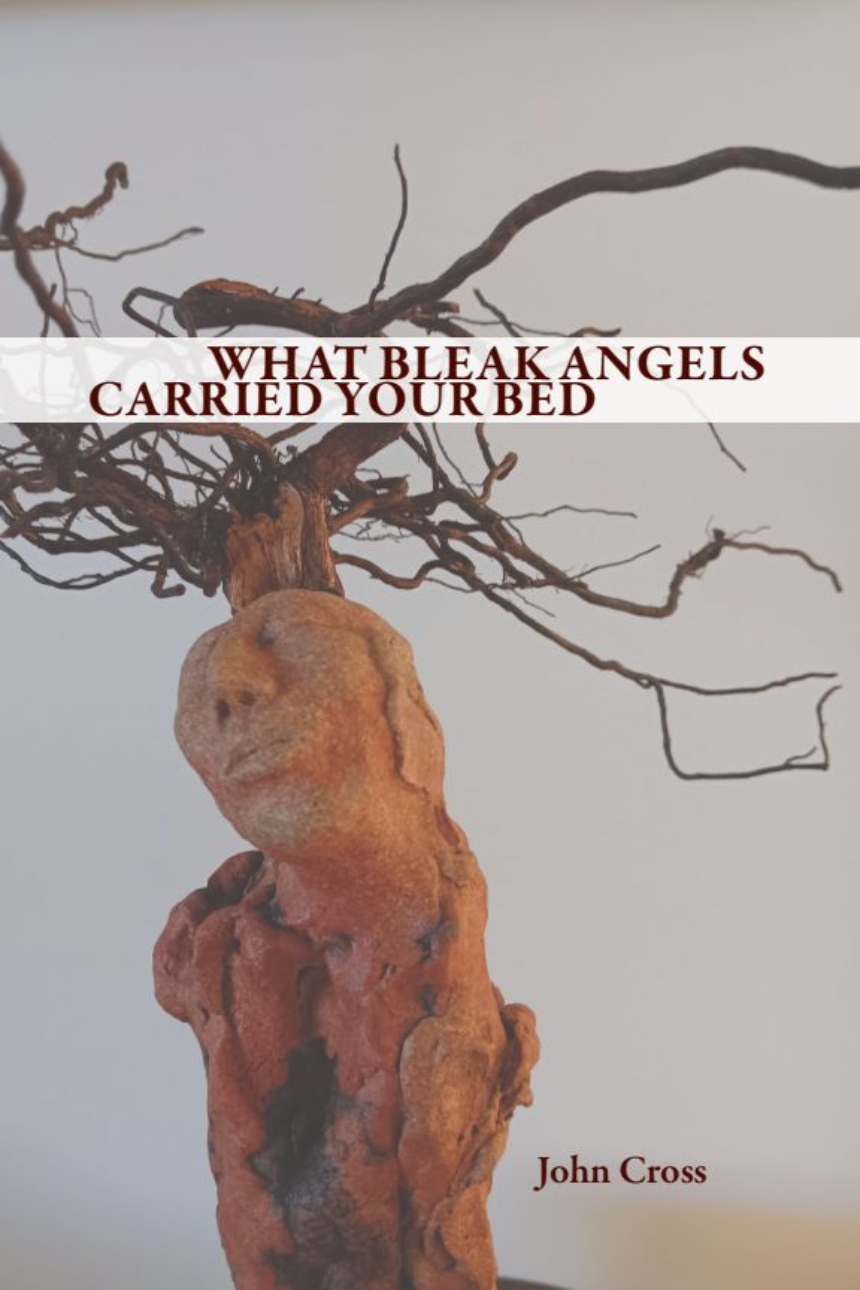
WHAT BLEAK ANGELS CARRIED YOUR BED by John Cross
What Bleak Angels Carried Your Bed offers the reader elegant and ruminative poems that address birth, songs, nature, and war. I was immediately struck by the first poem of the collection introducing a character named “Mathias” which opens with these lyrical fragments: “dark birds blazing from body very bareness stripped tree / a hole off center braves the debris.” The author’s inventive compositions delve into the metaphysical by incorporating visual experiments and surreal images: “The appliances are dying, singing their choir / The shudder & glow of wires sustains my milk.”
Cross’ debut poetry collection probes both the limits and potentials of exploring perception through language: “Something like love / unravels selvages, / tugs at each of our names / where the green lies watchful.”
— Maw Shein Win, judge’s citation
Published in Spring, 2026
https://press.uchicago.edu/ucp/books/book/distributed/W/bo265676916.html
~ ~ ~ ~ ~
Winner 2022:
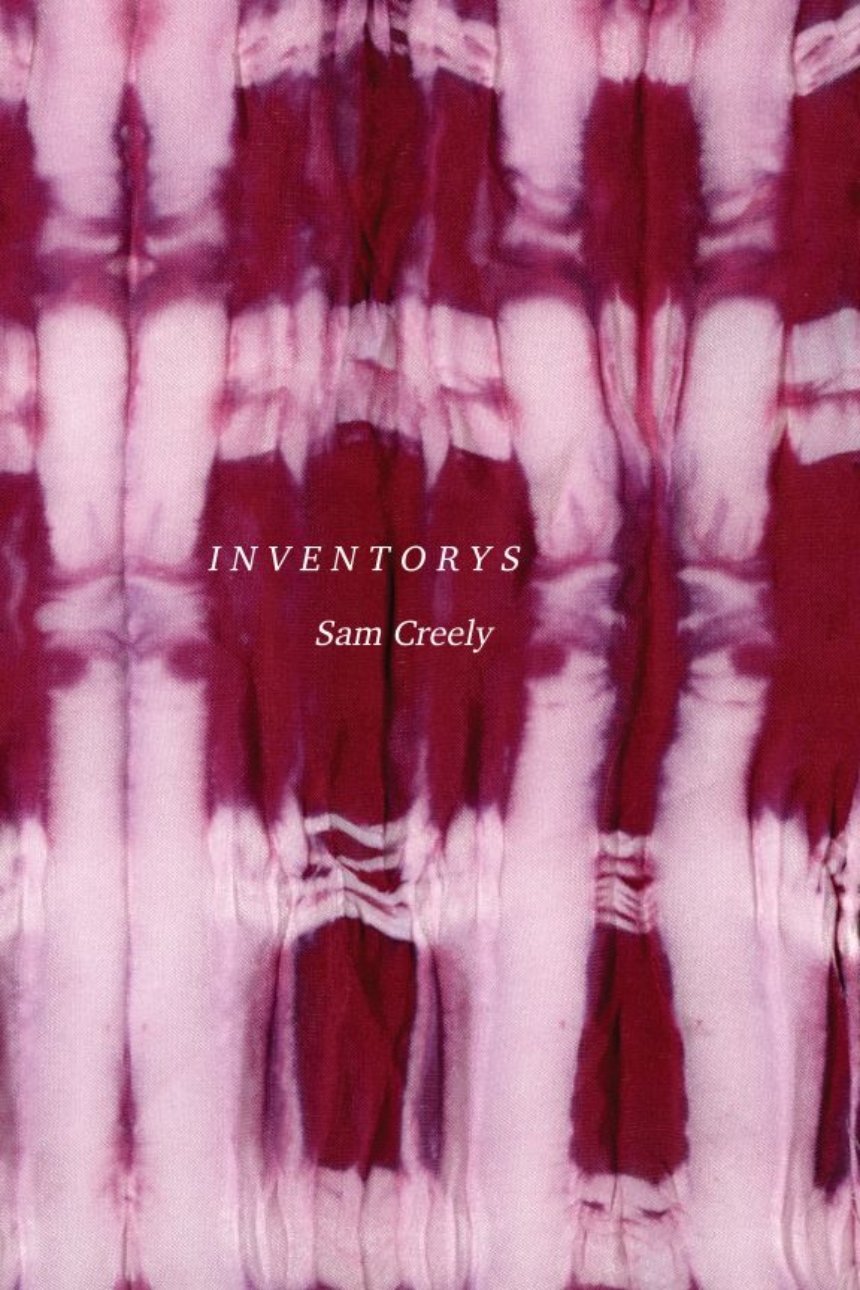
Inventorys by Sam Creely
Happily, when I unzipped the folder of the Omnidawn Open Book Contest semi-finalists, I discovered a number of manuscripts to which I might have with no qualms given the award; unhappily, of course, this meant I had to think hard before I settled upon a winner. But I’m glad I had to think hard—Sam Creely’s Inventorys is a book that rewards thinking. Indeed, if you’re anything like me, as soon as you read the first words of the first poem in the book you will find yourself required to think about one of the oldest and most central questions having to do with poetry: What kind of language is appropriate for the writing of poems? Ought a poem’s language to be elevated, or should it be casual? Should it be intricate, or direct? Should it to at least some degree play with standard syntax and grammar, or should it be written according to accepted conventions? Here’s how Inventorys begins:
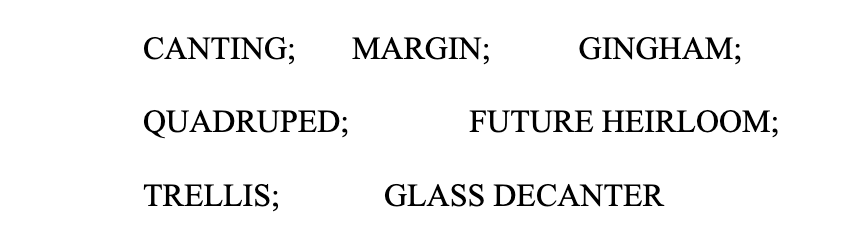
If you’re anything like me, you read those words and feel both excited and worried: Excited because the poet has obviously put real thought into their language, and worried because the stakes seem immediately higher than they might seem were the language of the poem more conventional. Has the poet created difficulties with their language they will not be able to overcome?
Well, no, they haven’t. Creely meets the challenge of those first lines again and again in Inventorys. More than that, they discover and implement, as the book unfolds, a voice that is both intellectually challenging and emotionally engaging, and again give the lie to that immortal, mistaken notion that the head and heart can’t work simultaneously—and even together!—fully and successfully. Inventorys rewards thinking and re-thinking, reading and re-reading, as all poetry must if it is to meet that ineffable hunger for poetry all readers of poems know, which cannot finally be sated, though it can be pleased. Inventorys pleases that hunger.
— Shane McCrae, judge’s citation
Published in Spring, 2025.
https://press.uchicago.edu/ucp/books/book/distributed/I/bo245011320.html
~ ~ ~ ~ ~
Winner 2021:
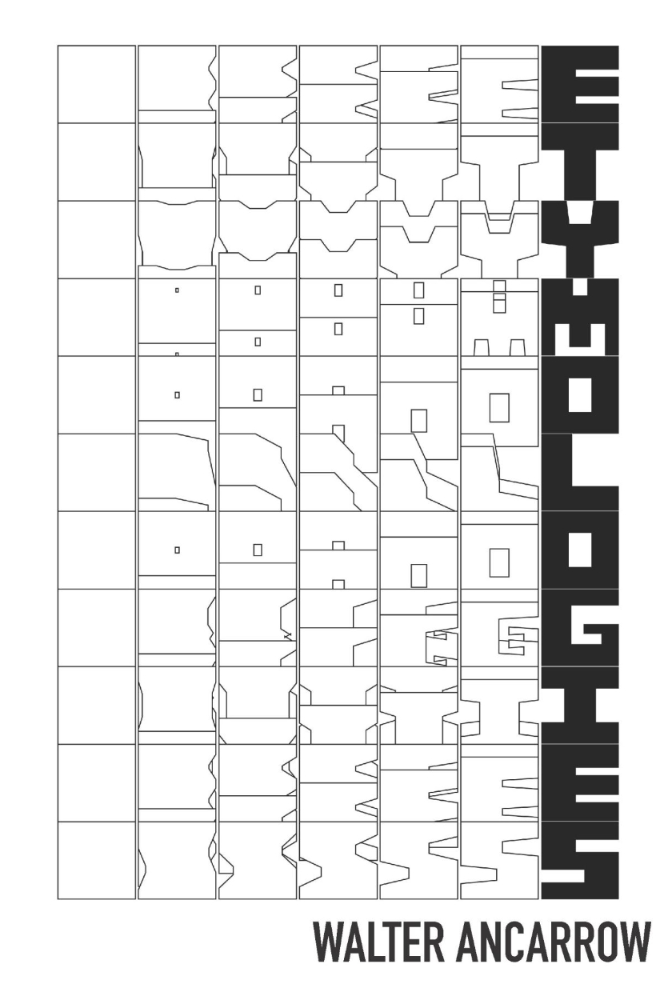
Etymologies by Walter Ancarrow
Ancarrow combines extreme precision with a wild imagination. In a ‘Note’ at the end of the book, he writes: ‘The etymologies in this book are correct, though not necessarily complete, sometimes poetically so.’ And therein lies the magic of Etymologies. The author seems to have made nothing up, to have been, it would appear, coolly objective throughout the writing of each study of a word’s origin. And yet, despite this claim, which I do not doubt, feelings and fancifulness emerge–like a swarm of genies freed from many bottles–at once impish, amatory, mysterious, provocative, funny, delightful, and dazzling.
— John Yau, judge’s citation
Published in Spring, 2023.
https://press.uchicago.edu/ucp/books/book/distributed/E/bo196817685.html
~ ~ ~ ~ ~
Winner 2020:
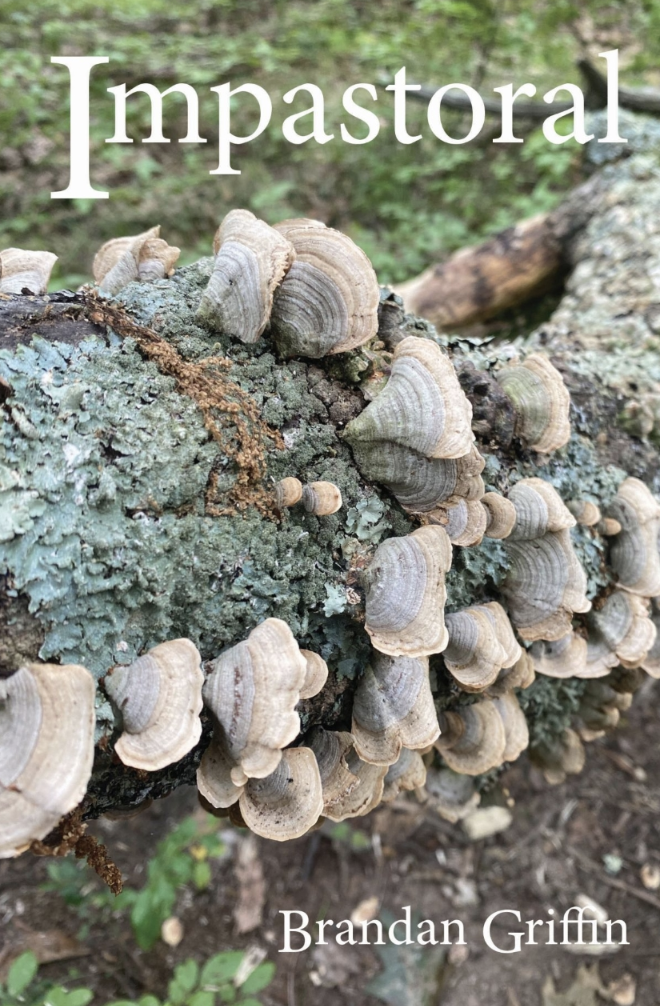
Pastoral by Brandan Griffin
Impastoral intervenes into the conventions of English orthography to grant words the capacity to visually register ‘telepithy’ between human and more-than-human beings. What appears on the page like misspelling is instead a spell-binding, the act of typing a sort of psychical sonar that allows the self to key into what lies far beyond itself: ‘why this one place that’s me/ while the sououound/ ripples and i/ wripple in it.’ The resulting poems are radical, records of mystical and ecological interconnection, prosodic and typographical experiences as ecstatic as they are wrenching. For the world to which Griffin’s poems are wired really is our world, as full of sewage and violence and digital signals as of animals and plants and insects, and to be intertwined is no paradise: ‘nature a sluice where/every creature gets flushed.’ Because these poems acknowledge the mortality at the core of being here so totally threaded together, I trust more their insights into their experience of what binds us in pleasure and wonder. And I adore this idiolect invented to let in more knowing, this language that claims, ‘The channels of gnosis are opening/again.’ Dear reader: it’s true. Ready yourself for a book like no other.
— Brian Teare, judge’s citation
Published in Spring, 2022.
https://press.uchicago.edu/ucp/books/book/distributed/I/bo166642369.html
~ ~ ~ ~ ~
Winner 2019:
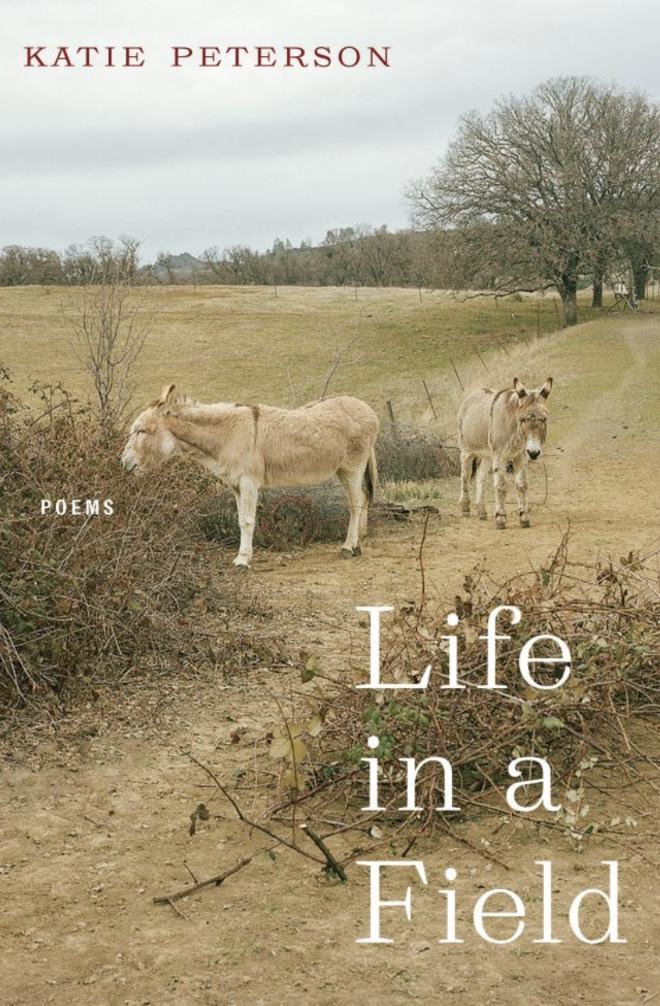
Life in a Field by Katie Peterson
“I found the book you are about to read delightfully easy to enjoy, and yet I find it difficult to explain what I love about it . . . Like most great poetry, Life in a Field is impossible to summarize or paraphrase. More than most poetry, it eludes formal categorization. Life in a Field is hybrid, mongrel—part allegory, part parable, part fable, part fairytale, part futurist pastoral set in the past or an alternate reality. . . . Life in a Field delights me in its simple, surprising, exquisite language.”
— Rachel Zucker, judge’s citation
Published in Spring, 2021.
https://press.uchicago.edu/ucp/books/book/distributed/L/bo91670311.html